The new President of the Cyprus International Businesses Association (CIBA), Vasilis Demetriades, speaks about foreign companies in Cyprus, the impacts of the Israel–Iran war, and recent allegations made by Phaedonas.
***“We need a holistic plan and policymaking that attracts foreign companies in a way that ensures multidimensional growth benefiting the whole society.”
***“We need a culture of governance that serves and is at the disposal of citizens and businesses—not just one that exercises authority.”
***“Educational institutions are not agile enough to adapt to modern labor market demands. There is a shortage in many specialties.”
***“Our universities and our entire educational approach should foster constructive curiosity that promotes critical thinking and creative alertness.”
***“If Iran closes the Strait of Hormuz, the shipping sector and, in a chain reaction, the entire supply chain and tourism will be affected.”
***“Frictions are mainly observed in the efficiency and effectiveness of the public sector. Time-consuming processes hinder foreign employees and their families.”
***“We have a long way to go regarding the factors that define quality of life in a country.”
***“Attracting foreign investment should not rely solely on low tax rates but also on knowledge transfer, education, and local workforce employment.”
***“Our geography, legal framework, EU membership, tax incentives, high-level professional services, and quality of life offer great appeal to foreign businesses.”
***“The government must remain alert and be an active listener—not just hear, but listen (to listen, not to hear).”
***“Beyond shipping, Cyprus hosts companies in tech, forex, healthcare, education, and training.”
***“There is a massive inflow of foreign skilled labor to Cyprus due to geopolitical shifts and targeted government policies over the past decade.”
***“Cyprus will soon adopt a new legal framework via the Direct Foreign Investment Screening Mechanism.”
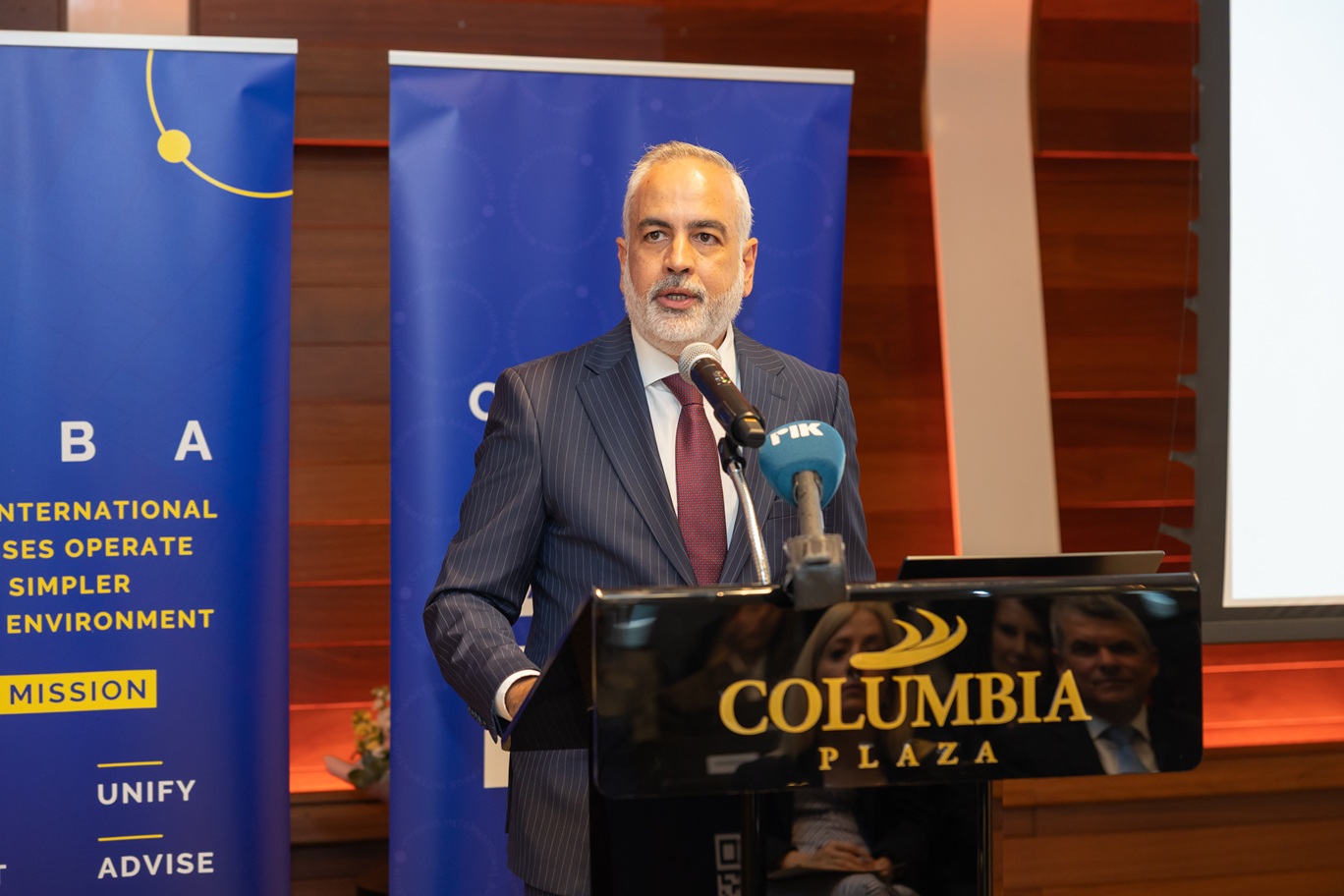
Vasilis Demetriades, former Deputy Minister of Shipping (2020–2023, under President Anastasiades), took over as CIBA President on April 16, 2025. CIBA represents the collective voice of international (foreign) businesses based in Cyprus. When asked about CIBA’s national and European role, Demetriades stressed it is multifaceted, extending beyond defending member interests.
“Once a company chooses Cyprus as an investment or operational hub, it’s vital to support them regarding existing processes, legal frameworks, taxation, and any issues that might affect their performance,” he said.
“We also develop positions and evidence-based proposals for national and EU legislation, always aiming to maintain and enhance Cyprus’s competitiveness, especially compared to other investment destinations. Our dual role is to support businesses while being honest partners with the government, offering our members’ expertise to improve or update processes that help them establish a stronger presence in Cyprus.”
Cyprus as an Attractive Destination
According to Demetriades, CIBA and its members are powerful tools the government can use to promote Cyprus internationally and keep its legislative environment competitive.
“Our members, with firsthand experience, can and should act as Cyprus’s ambassadors abroad,” he noted.
Cyprus remains attractive for numerous reasons, including its geographic location, EU membership, tax incentives, professional services, and quality of life. “Companies choosing Cyprus span many sectors: shipping, technology, forex, healthcare, and education,” he added.
Opportunities for Cypriots
Foreign companies contribute significantly to GDP and offer Cypriots employment and career development opportunities. “Sectors that wouldn’t otherwise exist bring unique opportunities to Cyprus. Working in multinational groups offers experience and know-how that enrich local society and instill a more advanced work culture and mindset.”
Are permanent, well-paid jobs being created for Cypriots?
“Yes. Foreign companies do hire Cypriots, and they usually pay well—depending on qualifications, experience, and individual value, regardless of nationality.”
On Wage Inflation and Skilled Immigration
Are higher average salaries due to foreign companies—mostly employing non-Cypriots—creating a distorted view of earnings in Cyprus?
“There’s no official data proving this. However, we do see a significant influx of skilled foreign professionals due to geopolitical shifts and deliberate Cypriot policies over the past ten years. This is not unique to Cyprus but a European trend. Companies offer competitive packages to attract talent, which may have raised average salaries.”
Growth Must Be Planned
Are the benefits of foreign companies in Cyprus greater than the problems, like high housing demand?
“All growth comes with side effects. Foreign companies shouldn’t be blamed for inflationary trends. We must not turn our back on development. What’s needed is a holistic plan and vision. We must consider that the tech company influx followed a global health crisis and the war in Ukraine. Yes, there are challenges, but long-term benefits outweigh them. Growth must be broad-based and shared across society.”
“To Listen, Not to Hear”
What should the state do to maintain Cyprus’s business competitiveness?
“The government must be vigilant, an active listener, not just a passive one. It should participate in EU legislation shaping, follow international trends, and proactively strengthen Cyprus’s position. It should embrace digital transformation to reduce bureaucracy and apply laws clearly and effectively, with a service-oriented mindset—not just authority.”
On Global Minimum Taxation
How will Cyprus’s competitiveness be affected by OECD’s global minimum tax (Pillar II)?
“We’re at a disadvantage since some EU and non-EU countries aren’t enforcing it or have delays. The Finance Ministry is analyzing the issue, and CIBA has already submitted its views. We hope that adjustments to the legal framework, in line with EU law, will mitigate negative effects.”
Red Tape and Bottlenecks
What are today’s key business challenges in Cyprus?
“Efficiency of the public sector remains a friction point. Red tape hinders foreign employees and their families. For example, the demand for English-speaking schools poses serious challenges. This is where the broader vision and holistic plan are needed—touching on finance, education, healthcare, infrastructure, transport, and connectivity. These factors define a country’s quality of life, and we have a long road ahead.”
Required Reforms
What reforms are needed to improve Cyprus’s investment climate?
“We need judicial reform, including digital and infrastructure upgrades. Also, we must implement the Foreign Direct Investment Screening Mechanism effectively. CIBA has been proactive in this, offering proposals to Parliament and the Finance Ministry based on EU and global trends. We also support the Vision 2035 strategy of the Competitiveness Council.”
Education and the Labor Market
Is education aligned with the job market?
“Progress is slow. Institutions aren’t agile enough. Many skills are lacking. Collaboration between universities and businesses is crucial. That’s why CIBA created a Training & Upskilling Committee to help identify needs and guide universities to adapt. We must innovate. Secondary education also needs major reform, especially as AI evolves. Education must be built on constructive curiosity and critical thinking.”
Public–Private Cooperation
Is there strong cooperation between the public and private sectors?
“There is significant room for improvement. As I mentioned, the state should use existing international businesses to attract more. Institutions like Invest Cyprus do good work, but they must integrate real-world insights from the companies already operating here.”
Israel–Iran: Prudence, Calmness, Responsibility Needed
Asked how the military operations between Israel and Iran—and the general risk of a wider conflict in the Middle East—might affect Cyprus and the international companies based here, Vassilis Demetriades stated that, at the moment, there is no reported concern from our members.
“What is needed is prudence and calmness, as well as very careful approaches and responsible statements from those in government so as not to create any negative climate or give false impressions that could harm the credibility of the Republic of Cyprus,” he noted.
If the volatile situation in the Middle East escalates into a generalized conflict?
Then consequences are expected for both the European and global economies. Specifically, if Iran closes the Strait of Hormuz, the shipping sector will likely be affected, which will in turn impact the entire supply chain. This would be due to longer routes being required, higher transportation costs resulting from increased fuel prices, and higher insurance premiums. The developments are also expected to affect other sectors, such as tourism.
In today’s global uncertainty—marked by trade and physical wars—do business opportunities still exist?
Geopolitical instability and uncertainty in general may be a hindrance to business growth, but for many, crisis can in itself be a great opportunity. Companies with innovative ideas, entrepreneurs who act smartly and take advantage of timing, and those who create favorable conditions for their business activities may emerge as winners.
One of the key prerequisites—or rather competitive advantages—during a crisis is liquidity. If liquidity is available at a time when the market in various sectors is low due to limited demand, then opportunities arise at particularly attractive costs, which will almost certainly rise in the near future.
That’s where real investment opportunities can and should be seized—especially by those with financial liquidity. Let’s not forget that crises create gaps in the market, either due to technological developments or the collapse of existing businesses. Startups can exploit those gaps by using cheaper financing—either from investors seeking better returns than bank interest rates, or from bank loans.
How do you view the Cypriot economy? How resilient is it? Has its model changed, or is it still based on tourism and services?
Over the past decade, a major effort has been made to get the Cypriot economy back on a growth path—something far from easy, considering the successive crises (banking crisis, pandemic, war in Ukraine and the Middle East). Regaining the trust of the markets is a significant achievement but should not lead to complacency.
There is ample room for improvement and much that needs to be done with prudence and rational planning. The resilience of the economy depends largely on how diversified or over-reliant it is on certain sectors.
Relying solely on specific sectors makes us vulnerable to potential crises and geopolitical shifts. That’s why we need a clear vision and strategic plan. Even the attraction of foreign investment should not depend solely on low tax rates, but also on other factors such as knowledge transfer, education and employment of local human capital, and environmental impact.
This way, we can lay the foundation for changing the economic model and reducing dependency on just 2–3 sectors.
Let’s not forget that Cyprus has a national problem that has remained unresolved for half a century. This major open wound is a very serious reason why we must make every possible effort to ensure that our economy is and remains resilient to crises—while also being able to seize opportunities for growth.
Complaints by Phaedon
Are there serious control mechanisms regarding the activities of foreign companies/businesses in Cyprus?
Absolutely. Such mechanisms do exist—for example, through the exercise of relevant responsibilities by the Central Bank, the Cyprus Securities and Exchange Commission, and the Commission for the Protection of Competition.
Cyprus is also expected to soon enter a new legal framework with the establishment and implementation of the Foreign Direct Investment (FDI) Screening Mechanism. This is an obligation of the Republic of Cyprus stemming from EU Regulation 2019/452.
Do the claims made by the Mayor of Paphos—that some foreign companies in Cyprus are laundering money through subsidiaries—have any basis?
Every public official and every citizen has the right to file a complaint or bring to the attention of the competent Authorities of the Republic of Cyprus any evidence, which should be investigated so that any case can be substantiated and supported.
It is not within my remit to comment on allegations or complaints.
With full respect for the competent Authorities, I consider any positioning by us at this stage to be inappropriate and misplaced.
Action Plan – Priorities
What are the priorities of CIBA’s Action Plan to strengthen the presence of international companies based in Cyprus?
Upon assuming the presidency of the association, I presented an Action Plan aimed at strengthening the presence and voice of international businesses based in Cyprus, as well as maximizing the wealth of expertise held by CIBA members.
Nearly two months later, the Plan has entered the implementation phase and includes, among others:
The creation of specialized committees, tasked with submitting well-documented proposals to the Board of Directors concerning the positions, challenges, and issues faced by international businesses operating in Cyprus. These include:
•European and International Affairs
•Legal Affairs
•Tax Affairs
•Environmental, Social, and Corporate Governance (ESG)
•Digital Technology
•Education and Skills Development (Training & Upskilling)
The establishment of an annual Report to be submitted to the President of the Republic and parliamentary parties, detailing the positions and problems faced by international companies in Cyprus, along with well-reasoned proposals to maintain and enhance their competitiveness—based on the output of the above committees.
The creation of new membership categories. Beyond the existing member categories, the Association is expanding membership to include private professionals, as well as startups and very small businesses, based on specific criteria.
A research initiative to gather insight into the experiences, challenges, and issues faced by international businesses in Cyprus, so that the positions presented to both the government and the House of Representatives fully reflect the expectations and demands of these companies, which form the backbone of the Cypriot economy.
Our goal is to support the efforts of each sitting government in creating an effective and attractive ecosystem for international businesses, through constructive and well-documented proposals derived from the knowledge, experiences, challenges, and suggestions of our members.
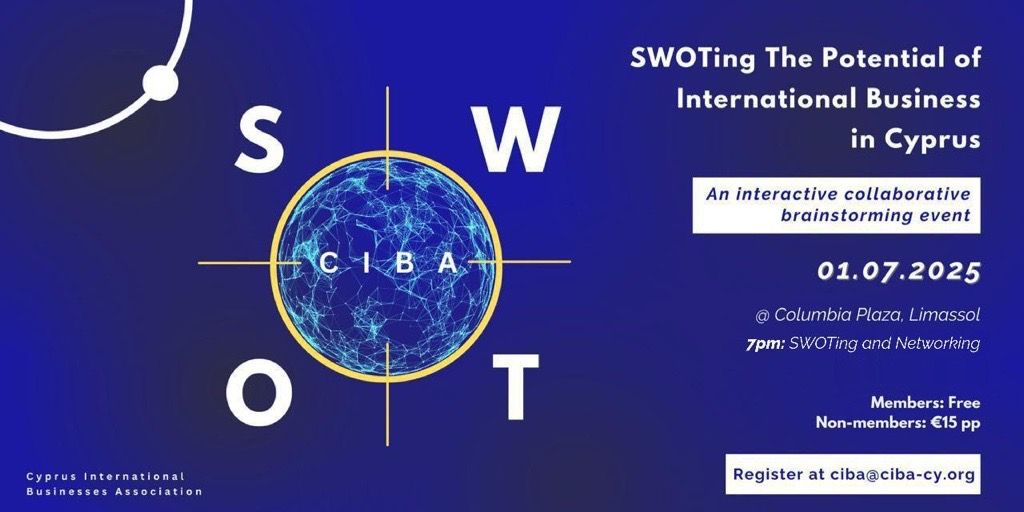
We will kick off on July 1st with an interactive SWOT Analysis, where we will explore the strengths, weaknesses, opportunities, and threats facing international businesses based in Cyprus.
This event is not limited to our members but is open to the entire business community of Cyprus.
I take this opportunity to congratulate the outgoing President of CIBA, Ms. Doxia Nikia Hatzivasileiou, for the important work she has accomplished at the Association, and to thank all members of the new Board of Directors—a mix of experienced and talented new executives, with whom I share a common vision:
To strengthen the presence of the international business sector in Cyprus, which will bring multiple benefits to the country.